


centerless grinding is a highly efficient and precise machining method widely used in mass production.
Centerless grinding has paved the way for more opportunities and new applications in manufacturing.
It is one of the machining techniques used by operators in the mass production of bar and cylindrical workpieces for the machining industry.
This article will mainly introduce the relevant knowledge of Centerless Grinding Machine adjustment. However, proper equipment adjustment is crucial for achieving stable machining results. For beginners, mastering the basic adjustment principles of centerless grinding machines is the key first step in achieving high-quality machining.
Centerless grinding typically does not use a center to hold the workpiece. Instead, it supports and processes the workpiece through three key components:
the grinding wheel (responsible for grinding), the guide wheel (controlling workpiece rotation), and the workpiece support plate.
The proper adjustment of these three components determines the machining accuracy.The grinding wheel of the centerless grinding machine rotates at high speed for grinding, while the guide wheel rotates at a slower speed in the same direction, driving the workpiece to rotate for circumferential feed.
In through-feed grinding, axial feed is achieved by adjusting the slight tilt angle of the guide wheel axis. This is suitable for grinding slender cylindrical workpieces, short shafts without center holes, and sleeve-like workpieces.
In plunge grinding, radial feed is achieved by moving the guide wheel head or grinding wheel head. This is suitable for grinding workpieces with shoulders or bosses, as well as conical, spherical, or other workpieces with curved generatrices.
Centerless grinding machines have high productivity and are easily automated with various loading and unloading devices, making them mostly used for mass production.
Machines can be classified according to the type of centerless grinding area. In moving-area or three-sliding machines, the grinding wheel is fixed during operation, and the movement of the X, Z, and B axes (grind wheel tilt) is controlled from the adjustment side.
This arrangement provides a compact design and excellent rigidity. However, when the grinding wheel wears, more frequent adjustments to the table support are required, although this is easily compensated for as it is located on a separate CNC slide.
Grinding any part, including workpieces with recesses of varying diameters, requires angle grinding. To make centerless grinders suitable for high-precision applications, the operation of these two grinding machines can be combined into one.
The adjustable grinding wheel head can rotate horizontally and has permanently fixed table inserts. During centerless grinding, the adjusting wheel presses the workpiece at an angle against the grinding wheel profile.
This also allows for grinding highly complex parts with multiple grooves. The grinding wheel head is rigid and has only one feed axis.
The height-adjustable table insert is a programmable function with special control software that automatically calculates the ideal position of the insert.
These calculations are based on preset parameters derived from the manufacturer's testing and research, and the axis is aligned according to the resulting input values.
These calculations are designed to fill in the intuitive estimates and iterative adjustments made by a skilled operator.
When the adjusting wheel wears, the positions of both the adjusting wheel and the table insert are automatically reset by adjusting the height of the dressing.
Junkers control electronics perform this compensation by correspondingly tracking the grinding and adjusting wheel, thus always ensuring accurate and consistent grinding.
After each dressing cycle, the position is automatically recalculated and the grinding wheel is calibrated. Furthermore, the concentricity quality remains unchanged, and less time is needed to adjust the centerless grinding process without affecting performance.
1. First, adjust the distance between the cutting tool and the grinding wheel. Then, adjust the guide wheel to approximately the diameter of the workpiece.
Place the workpiece between the guide wheel and the grinding wheel, and slowly advance the guide wheel until it slightly clamps the workpiece.
Push it back and forth to find the contact point. The contact point should be in the middle; you should feel the workpiece is loose at the front and back, and slightly tight in the middle.
2. Place the workpiece in. Generally, using a workpiece slightly longer than the guide plate yields better results. Place one-third of the workpiece between the grinding wheel and the guide wheel.
At this point, the workpiece should not be squeezed. The workpiece should move smoothly in and out.
Use a wooden stick or other object to press down on the workpiece surface of the grinding wheel to make the workpiece parallel to the guide wheel surface. Then adjust the guide plate to be flush with the workpiece surface.
Carefully observe the contact between the guide plate and the workpiece at the front and back; there should be no gaps, especially at the back, as gaps will cause wobbling.
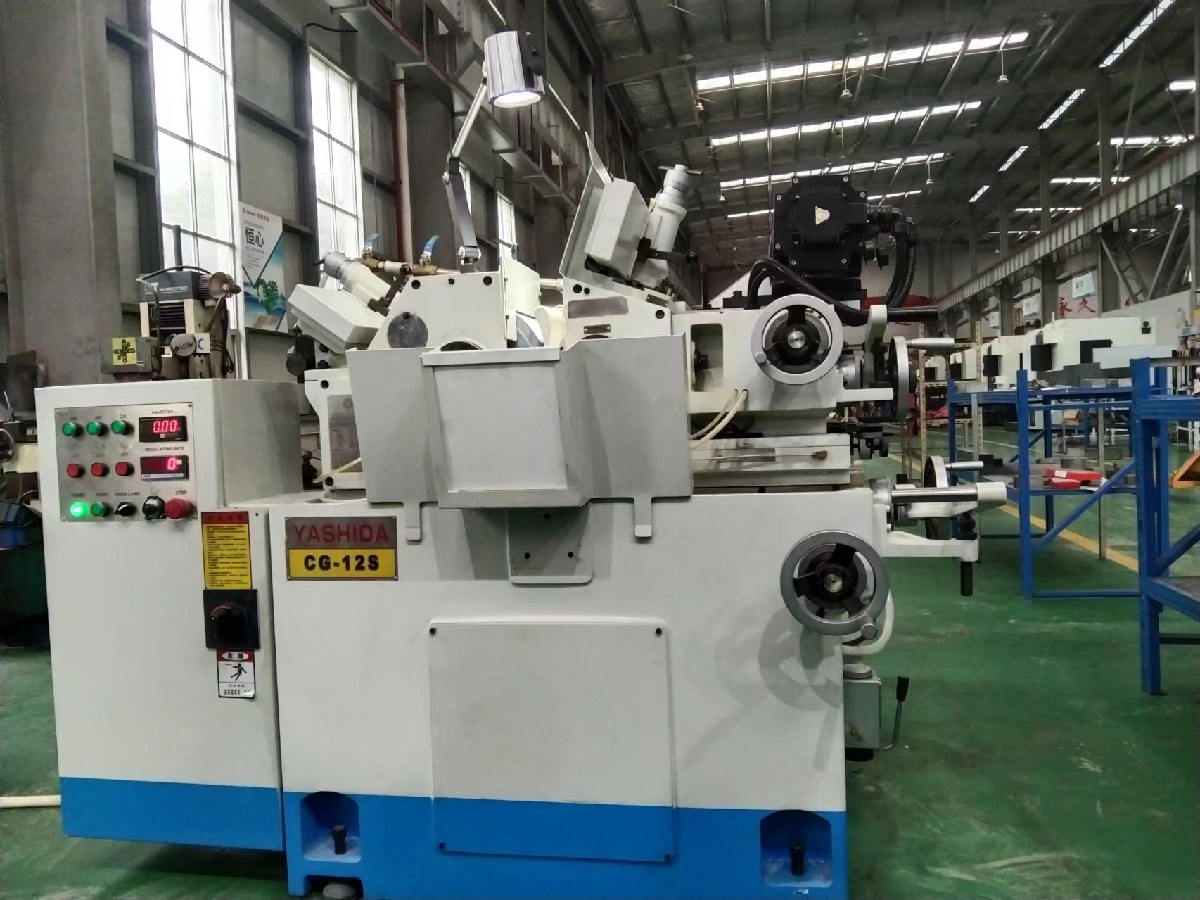
Learning the correct setup for a centerless grinder, including selecting the correct grinding wheel, helps avoid many errors that can occur during the subsequent grinding process.
First, begin by setting the appropriate working height. Height controls the centerline of the workpiece, which determines the rounding process of the grinding operation. Workpiece height is a crucial metric and should not be overlooked.
If unsure how to set the workpiece height, consider the following rule of thumb: If the workpiece diameter is 1 inch, ensure that half of it is above the centerline of the grinding wheel and the adjusting wheel.
This primary setting must be correct for the grinding process to be effective. Next, ensure that the correct grinding insert angle is set.
This angle should be between 0 and 45 degrees. However, for most centerless applications, a top insert angle of 30 degrees should provide ideal results.
While steeper insert angles allow for very fast rounding, shallower insert angles will be suitable for larger diameter workpieces. However, starting with 30 degrees is safe.
Set the speed of the centerless grinder's adjusting wheel. Although its rotational speed depends on the workpiece diameter and the machine's blank removal rate, it can be adjusted to 30 revolutions per minute.
The low speed of the adjusting wheel ensures optimized grinding process.
The grinding and adjusting wheels firmly hold the workpiece on the worktable, allowing even very thin parts to be ground.
In summary, mastering the basic setup methods of a centerless grinder is a crucial foundation for achieving high-precision machining.
YASHIDA has 37 years of experience in high-precision grinding and is an experienced centerless grinder manufacturer, offering a variety of high-precision manual and CNC centerless grinders, such as the CG-18CNC (single-axis to five-axis).
There is much experience and skill to share regarding centerless grinders; beginners can only quickly improve their operating skills and achieve stable and efficient production through continuous practice and optimization.

Learn more about centerless grinder:
How Roundness Is Achieved in Centerless Grinding
Centerless Grinding Solutions for Automotive Precision Shafts
The Role of Regulating Wheel Control in Centerless Grinding Accuracy
High-Precision Centerless Grinding Solutions for Automotive Manufacturing
This website uses cookies to ensure you get the best experience on our website.
 Español
 Portugues
 Pусский
 العربية



 Phone
Phone
Comment
(0)