

In centerless grinding, accuracy is achieved without traditional workholding such as chucks or centers. Instead, precision depends heavily on the interaction between the grinding wheel, the regulating wheel, and the work rest blade.
Among these components, the regulating wheel plays a decisive role in controlling workpiece rotation speed, axial feed, roundness, and straightness. Proper regulating wheel control is therefore essential for achieving high-accuracy centerless grinding.

The regulating wheel is responsible for driving the workpiece rotation and controlling its axial movement during grinding.
Unlike the grinding wheel, which removes material, the regulating wheel operates at a lower speed and is usually made of rubber-bonded or resin-bonded abrasive. Its speed, angle, and position determine how the workpiece behaves throughout the grinding process.
Workpiece roundness is closely related to the stability of rotation.
If the regulating wheel speed is unstable or improperly set, the workpiece may experience micro-slipping or inconsistent rotation, leading to roundness errors. Precise speed control ensures smooth and constant rotation, which is critical for achieving tight roundness tolerances.
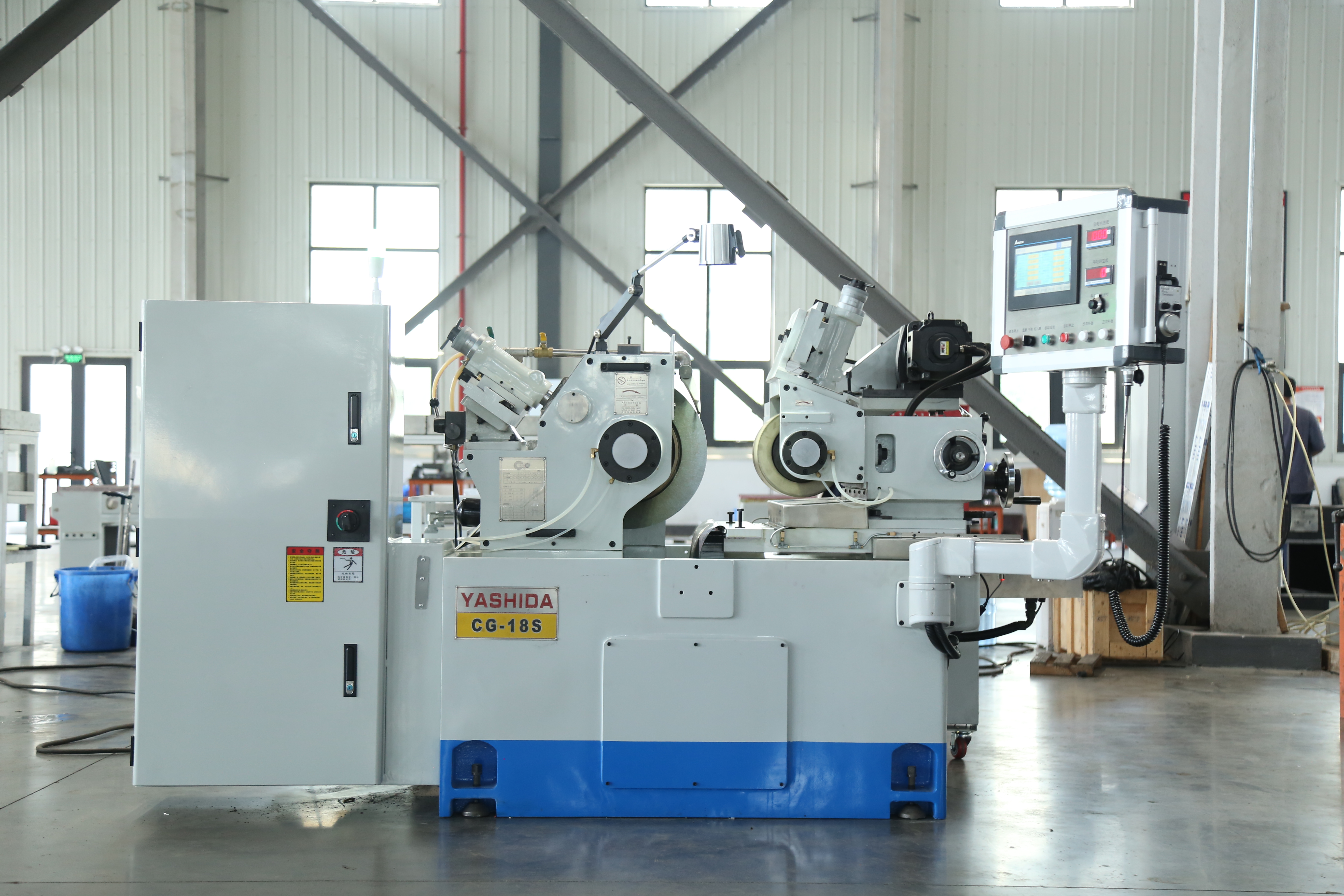
YASHIDA centerless grinders use precise regulating wheel drive systems with stable speed control, helping maintain consistent rotation and improved roundness accuracy.
The inclination angle of the regulating wheel determines the axial feed of the workpiece.
A correctly set angle ensures uniform axial movement during through-feed grinding. Any deviation can cause taper, barrel shapes, or waviness along the workpiece length. Accurate angle adjustment is therefore essential for achieving high straightness.
YASHIDA centerless grinders are designed with precise and user-friendly regulating wheel angle adjustment mechanisms, allowing operators to fine-tune straightness with confidence.

The relative position between the regulating wheel, grinding wheel, and work rest blade directly affects size control and process stability.
Improper positioning can cause vibration, size variation, or unstable grinding conditions. High-quality centerless grinders offer rigid adjustment structures to ensure repeatable and accurate setup.
YASHIDA centerless grinders feature robust regulating wheel support structures that maintain alignment even during long production runs, improving size consistency and process reliability.
Modern centerless grinding increasingly relies on CNC control to reduce operator dependency.
CNC systems can precisely control regulating wheel speed, feed rate, and grinding cycles, enabling repeatable accuracy across batches. YASHIDA CNC centerless grinders integrate advanced control systems that allow precise parameter programming, making them ideal for high-volume and high-precision applications.
The regulating wheel is a critical factor in determining centerless grinding accuracy. Its speed, angle, and position directly influence roundness, straightness, and dimensional consistency.
By combining precise regulating wheel control, rigid machine structure, and advanced CNC technology, YASHIDA centerless grinders deliver stable, repeatable, and high-accuracy grinding solutions for demanding manufacturing environments.
This website uses cookies to ensure you get the best experience on our website.
 Español
 Portugues
 Pусский
 العربية



 Phone
Phone
Comment
(0)